Sign in
 Sign up





































On 26 August 2026 Dubai's shared housing law comes into force — the format where a flat is let room by room or bed space by bed space while the kitchen and bathroom stay communal. What used to be a large grey area now moves into a permit regime: letting a property this way without municipal approval is prohibited, and a repeat breach carries a fine of up to AED 1 million (about USD 272,000). At the same time the way rent itself is paid is changing: the Land Department is preparing an interest-free instalment scheme under which the landlord receives the full annual sum upfront. Here is what changes, who it affects, and how it alters the calculations of any owner who lets property.
Contents:
What exactly takes effect on 26 August
The law was published in the official gazette on 27 February 2026 and comes into force 180 days after publication. Shared housing is defined as an arrangement where a resident has their own designated space while the kitchen, bathrooms and yard remain communal. The regime covers flats, houses, townhouses and mixed-use buildings — in other words, almost the entire residential stock of the city.
The key change: converting a property to this format is no longer the owner's decision alone. It requires a permit from Dubai Municipality, issued jointly with the Land Department for one year with the option of two, and renewal applications go in 30 days before expiry. The property itself must meet standards on occupancy density, layout, fire safety, sanitation, electrical systems and security.
The law also settles who may let. Only the owner or an organisation authorised by the owner. A tenant cannot pass the property on: subletting and taking in additional occupants are prohibited, and the presence of third parties requires the owner's written consent. Payment terms are set out separately — by default rent in this format is paid monthly, with electricity and water included in the payment, and anything else requires a written agreement between the parties.
The six categories of residents the format is permitted for:
- Families — shared living within a single family.
- Women — accommodation separate from men.
- Men — accommodation separate from women.
- Female students — housing tied to study.
- Male students — the same for male students.
- Employees — staff of government bodies and private companies.
Fines and deadlines: what a breach costs
| Consequence | Scale and conditions |
|---|---|
| Fine for a first breach | From AED 500 to AED 500,000, roughly USD 136–136,000 |
| Fine for a repeat breach within a year | Up to AED 1 million, about USD 272,000 |
| Suspension of activity | Up to six months |
| Cancellation of the permit | Full withdrawal of the issued permit |
| Licence withdrawal | For companies managing such properties |
| Disconnection of utilities | Electricity and water at the property |
There is also a transition period: owners have a year to bring properties into compliance, until 26 August 2027. Anyone whose flat is currently let room by room therefore has twelve months to obtain a permit or change the letting format.
What this means for an owner who lets property
- Check your letting format. If the flat is let to a single family or a single tenant under one contract, nothing needs to be done — the law targets shared occupancy specifically.
- Assess whether the property meets the standards. Requirements on layout, occupancy density and fire safety have to be met before the application, not after.
- Plan the timeline. The permit runs for one or two years and renewal goes in 30 days ahead — a separate entry in the owner's calendar.
- Recalculate the yield. Monthly payments with utilities included change the familiar arrangement, where the annual sum arrived at once and the tenant paid the water and electricity bills.
- Check what your tenant is doing. If a flat is let to one person but six are living in it, the owner is the one answering to the municipality.
Paying rent: a year upfront is no longer the only option
The second change affects every tenant in Dubai, not just shared housing. For years the standard here was payment for the year in a single cheque, or split across two to four cheques, with fewer cheques buying a lower price. For an arriving expat that meant producing a large sum immediately, before they had even settled into the city.
In June 2026 the Land Department launched Flexi Rent, which added monthly, quarterly and half-yearly payment options. The next step is now in preparation: a scheme where a partner bank pays the landlord the full annual amount upfront while the tenant repays the bank in equal instalments over twelve months at zero interest. The formal launch is announced for September 2026, when eligibility conditions and the payment mechanism are due to be published; the bank has not been named.
For a property owner this is more attractive than it first appears. They receive the money a year ahead — keeping the arrangement Dubai is used to — while the pool of potential tenants widens to include those who previously could not assemble the annual sum. The scheme has not launched yet, so building calculations on it would be premature, but it belongs in the autumn planning.

Rents are falling — the second factor in the calculation
The rules are changing against a backdrop of falling prices. Rents in Dubai came down by roughly 6% over the quarter, with the sharpest declines in districts where many new towers complete at once: owners there compete for the same tenant. The two factors together — tighter requirements on the letting format and lower yields — force a fresh calculation of a property's economics.
This applies particularly to anyone who bought studios and small flats specifically to let room by room. That scenario delivered higher returns precisely because it sat outside regulation. Now it carries the cost of bringing the property into compliance, utilities built into the payment, and the risk of a fine. Last year's model no longer works for calculating the yield.
A new format: neighbourhoods that are not for sale
Another shift is visible on the developer side. In Jumeirah 1, on the site of the former Dubai Zoo, a neighbourhood of 90 homes is under construction and not one of them will go on sale. Low-rise buildings around a central park with mature trees preserved, a clubhouse, a wellness zone, a pool and a playground — the entire neighbourhood stays with the developer and will be let. No completion date has been announced.
This is the build-to-rent model, familiar from London and New York and new to Dubai. For a tenant it means more predictable quality: the building is run by one company rather than by a hundred and fifty private owners with differing ideas about renovation. For a private investor it is a competitor of a new kind — a professional landlord with its own management, service and marketing budget.
How this shapes the choice of a rental property
- Look at transport. Dubai's public transport carried 348.1 million passengers in the half-year, around 1.9 million a day, with the metro accounting for 39.2%. The busiest interchanges are BurJuman and Union. Housing within walking distance of a station lets faster and holds its rate better.
- Count over a longer distance. While a large volume of new flats keeps reaching the market, short high-yield scenarios carry more risk than long ones.
- Check the building's management company. House rules and its stance on short-term letting shape your options as much as city regulations do.
- Do not count on grey arrangements. Letting rooms without a permit can now lead to utilities being cut off, and responsibility rests with the owner.
- Keep the competition in mind. Alongside private owners, entire neighbourhoods under professional rental management are appearing.
Sample properties
-
8 330 AEDper month
- AED
- EUR €
- USD $
- RUB ₽
- GBP £
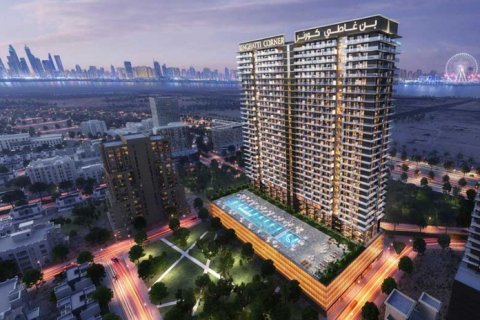 Apartment in BINGHATTI CORNER in Jumeirah Village Circle, Dubai, UAE 1 bedroom, 63.63 sq.m. № 590422Bedrooms: 1Bathrooms: 1Living space: 63.63 m²Pay in 4 Cheques | Spacious 1 BR | Vacant | 75K per year Details
 -
70 000 AEDper month
- AED
- EUR €
- USD $
- RUB ₽
- GBP £
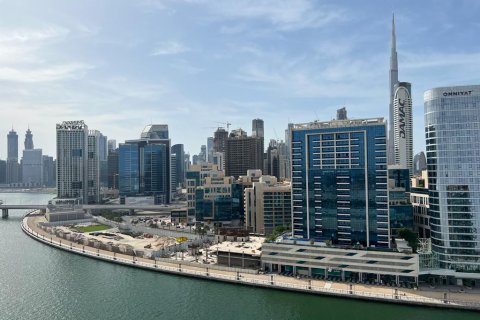 Bedrooms: 1Bathrooms: 2Living space: 75.23 m²FULL CANAL VIEW | PRIME LOCATION | SPACIOUS 1 BDR Details
 -
8 500 AEDper month
- AED
- EUR €
- USD $
- RUB ₽
- GBP £
 Rooms: StudioBathrooms: 1Living space: 65.1 m²