Sign in
 Sign up





































The first half of 2026 ended with a result few had predicted: the country's biggest seller of homes was not a Dubai company. Modon, a developer from Abu Dhabi, sold AED 23 billion worth of property (USD 6.3 billion) and edged past Emaar with its AED 22.4 billion (USD 6.1 billion) — the same Emaar that built the Burj Khalifa and half of downtown Dubai. Together, the country's ten largest developers sold AED 113.7 billion worth of homes, roughly USD 31 billion. The change at the top is not a quirk of one report. Behind it sits a shift in where buyers put their money: Dubai is cooling for the first time in years, while its neighbours are climbing. Here is what is happening in each of the four emirates, and what it means for anyone choosing a property.
Contents:
Dubai: so many homes were handed over that prices turned down
For several years the Dubai market ran on launches — what sold was what had not been built yet. Now the handover phase has arrived. More than 13,200 flats and villas were completed in the second quarter of 2026, another 32,000 are due before the year ends, and the pipeline of announced projects stretches to 2030. The market cannot absorb that volume at once, and price tags have responded. Home prices fell by roughly 4% over the quarter, and rents by 6%.
The best-known addresses took the hardest hit. Flats on Palm Jumeirah lost about 9% of their value, while Downtown and Business Bay each shed 7%. The gap is wider in the rental market: Downtown is down 14%, Dubai Hills Estate 10–12%, Dubai Marina 10% and the Palm 9%. Established communities where families actually live are holding up better — fewer units come to market at the same time there, and owners are in no hurry to cut prices.
For buyers, this is a reversal. A year ago there was barely anyone to negotiate with in Dubai: good units were gone within days. Today a buyer has both time and leverage.
The market has moved from a phase where speed decided everything to one where the quality of the property decides — for the first time in years buyers can compare rather than grab, analysts covering the emirate's property market note.
The flip side is the same fact seen from the other end. Anyone who planned to buy at foundation stage and flip before handover now faces a market with another thirty thousand fresh flats standing next door. Selling such a unit quickly and at a profit will be harder, which pushes short speculative deals aside in favour of rental income and a longer horizon.
Abu Dhabi: the capital gained 17.8% and moved into construction
The capital is doing the opposite. Over the year homes in Abu Dhabi rose 17.8% in value, with flats up 24.1% and villas up 12%. The average deal came to AED 4.14 million, around USD 1.13 million. Growth is uneven: Al Reef gained 41.6%, Al Munira Island 24.7% and Al Reem Island 22%. In other words, picking the right location inside the city now matters more than the decision to buy in Abu Dhabi at all.
The telling part is where the money goes. Off-plan property accounted for 84% of all residential deals, rising 156% year on year to 6,061 transactions. Deals involving completed homes fell 28.3% over the same period, to 1,145. Off-plan has become the default format in Abu Dhabi: buyers are backing what has not been built yet and expect their keys in two to three years.
One detail usually surprises newcomers: unbuilt homes in the capital cost more than finished ones. A square foot off-plan goes for AED 2,104 — about USD 6,200 per square metre — and the price is up 21.2% over the year. Completed housing sells at AED 1,442 per square foot, roughly USD 4,200 per square metre, up 10.9%. The reason is straightforward: new projects launch in the better locations, with modern layouts and payment spread across the construction period, while Abu Dhabi's existing stock is noticeably older than Dubai's. Buyers are paying for what they will receive in three years, not for the square metres in front of them.
Sharjah: twice as many deals, yet a cheaper square metre
The third-largest emirate sits right next to Dubai — from some districts the drive to central Dubai takes twenty minutes. Sharjah recorded 13,081 residential transactions in the first half of the year, against 6,140 a year earlier. Across all property operations the count reached 59,460 deals, up almost 24%. Eleven new projects were registered, and buyers came from 121 countries.
Prices, however, went down rather than up. Flats sell at AED 1,010 per square foot — around USD 2,960 per square metre, down 8.2% over the year. Villas are holding better at AED 970 per square foot, roughly USD 2,840 per square metre, up 5.4%. The combination of twice the deals at a lower price is unusual, and it points to one thing: a large volume of new mid-market supply has reached the market, and sellers are competing for buyers.
Who those buyers are becomes clear from a separate set of figures. Emirati nationals aged 18 to 35 alone accounted for 5,314 investors, who closed 7,052 deals worth AED 4.3 billion (about USD 1.2 billion). Mortgage registrations in the second quarter were 51% higher than in the first. This is not speculative money but domestic demand for homes to live in: young families buy on credit where it is cheaper and commute to work in Dubai.


Fujairah: the emirate betting on a railway
Fujairah stands apart in the literal sense — it is the only emirate on the Indian Ocean coast, beyond the Hajar Mountains and outside the Arabian Gulf. The beaches are quieter, buildings are lower, and the property market is so small that reviews rarely mention it. A railway may change that: the Etihad Rail network is launching passenger services, with three stations serving Fujairah, Saqamkam and Al Hilal City. More than 70,000 tickets have already been sold on the first routes.
Market participants broadly agree that well-placed properties near the stations could rise 20–30% in value — not next year, but over a 2029–2031 horizon. The first interest is going to land plots and villas around the Fujairah and Saqamkam stations.
The map of supply shortages and the map of new inter-emirate transport infrastructure have started to overlap for the first time, an expert on the UAE property market says.
It is worth being clear that this is a specialist forecast, not a fact or a guarantee. The Fujairah market is thin: few buyers, few properties, and selling quickly is harder here than in Dubai. The option suits someone entering for 5-7 years who is not planning a quick exit.
Four emirates in one table
| Emirate | Prices | Demand | Who is buying |
|---|---|---|---|
| Dubai | Down 4% over the quarter, rents down 6% | 32,000 new flats due before year end | Foreign investors and tenants |
| Abu Dhabi | Up 17.8% over the year, flats up 24.1% | 84% of deals are off-plan | Investors in new projects, residents |
| Sharjah | Flats down 8.2% year on year, villas up 5.4% | Twice as many deals year on year | Local families buying with mortgages |
| Fujairah | Forecast of 20–30% growth by 2029–2031 | Small market, waking up around the railway | Long-term buyers, land and villas |
Which emirate suits whom
- Dubai — if liquidity matters and you want to be able to sell within a reasonable time. It has the deepest rental market and the clearest transaction process, yet buying for a quick resale right now carries risk: competition from new completions will keep growing for another two years.
- Abu Dhabi — if your horizon is three years or more and buying at construction stage does not worry you. The capital is growing faster, but its resale market is thinner than Dubai's, so exiting a property takes longer.
- Sharjah — if the entry price is the priority. The threshold is close to half of Dubai's, and the Dubai business district is a short drive away. The trade-off: the market is geared to local residents, so a foreign tenant with a high budget is a rarer find.
- Fujairah — if this is a deliberate bet on infrastructure with a 5-7 year horizon. Not for anyone who needs the option to exit at any moment.
One point deserves separate attention before any deposit is paid. Ownership rules for foreign buyers in the UAE differ not only between emirates but between districts within a single city. In some areas full ownership is available, in others only a long-term right of use. The status of a specific property is confirmed by the developer's documents and by records held at the emirate's land department — this is the case where general articles found online are no substitute for checking a particular address.
Sample properties
-
5 900 000 AED
- AED
- EUR €
- USD $
- RUB ₽
- GBP £
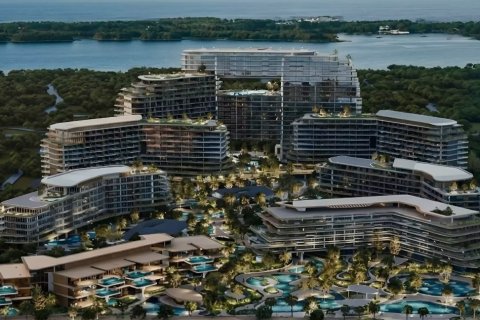 Bedrooms: 3Bathrooms: 4Living space: 157.93 m²The Meriva Collection by Ellington Properties is a newly launched luxury beachfront residential project in Dubai Islands. Residential Amenities: * Premium fitness center with state-of-the-art... Details
 -
19 500 000 AED
- AED
- EUR €
- USD $
- RUB ₽
- GBP £
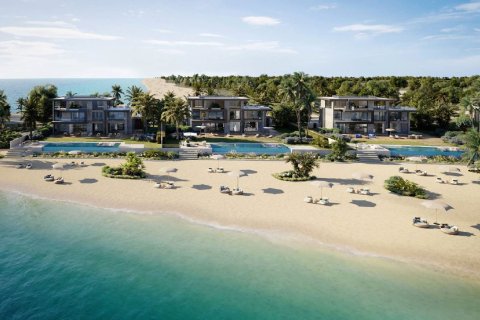 Bedrooms: 6Bathrooms: 7Living space: 846 m²Jacob & Co. Beachfront Living redefines luxury living along the serene shores of Abu Dhabi's prestigious Al Jurf district. Developed by Ohana Real Estate Development, this unique project merges... Details
 -
115 330 000 AED
- AED
- EUR €
- USD $
- RUB ₽
- GBP £
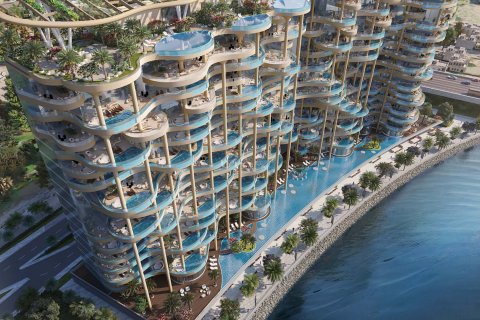 Bedrooms: 6Living space: 2239.5 m²Distance to the sea: 2 km